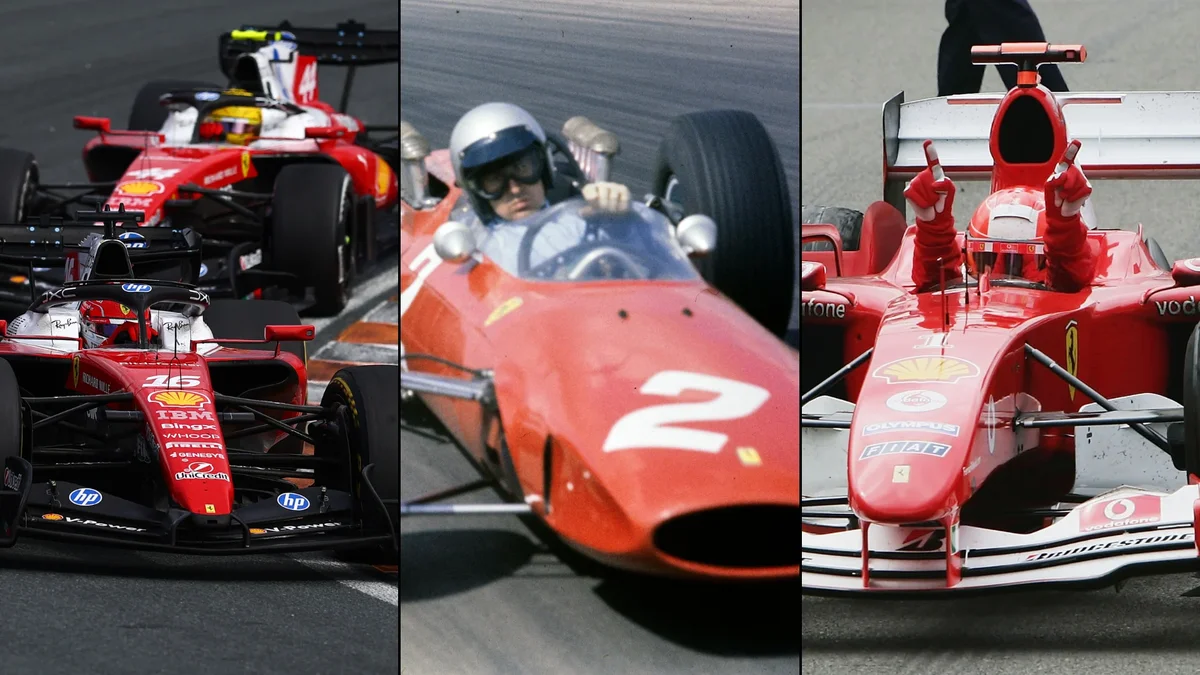


Ask a child to draw a car, and he will certainly colour it red, as Enzo Ferrari famously said. It is hard to imagine Formula 1 without Scuderia Ferrari and their iconic Rosso Corsa scarlet, a partnership that defines motorsport. Ahead of the Italian Grand Prix in Monza, the team is running a special Schumacher-inspired livery featuring seven stars on the front nose to commemorate Michael Schumacher's 1996 victory at the Temple of Speed and his seven Drivers' Championships.
Ferrari stands as the most successful team in Formula 1 history, boasting a record 16 Constructors' Championships while remaining permanently linked to vibrant red paintwork. Before teams could customise their liveries freely, cars were colour-coded by nationality to identify where a competitor was from. Italy was red, shared by Ferrari along with other Italian manufacturers like Alfa Romeo and Maserati in the early seasons of the Formula 1 World Championship. Meanwhile, France was blue, Great Britain was green, and Germany was white, with all these connections dating back to the 1900s. Enzo Ferrari, fiercely proud of his heritage, wanted to showcase his passion by running his machines in the mandated national colour, starting with the very first car to emerge from the Maranello base—the Ferrari 125 S which debuted in May 1947 in racing red. Rules were later relaxed for the 1968 season regarding sponsorship, altering the commercial landscape of the sport forever.
Rosso Corsa, literally translating to Racing Red, is the flat shade without metallic flakes designed to look quick and highlight the lines of the car. While this retro-feeling hue returns this weekend, the squad typically uses a lighter shade titled Rosso Scuderia, specifically created to have more visual pop on television screens. They have also experimented with darker shades, such as the burgundy used for their 1000th Grand Prix livery, which paid tribute to a similar colour seen on the cars at the 1950 Monaco Grand Prix.
Despite the endless red, Ferrari have indeed raced in other colours. While modern machines have featured pops of colour like yellow at the 2022 Italian Grand Prix or blue at the 2024 Miami Grand Prix, the last time the works team ran a fully non-red car was in 1964. Enzo Ferrari ordered a blue-and-white paint job for the final two races of that season in protest after the governing body refused to homologate his new machine for the World Sportscar Championship. The blue and white look, which shocked the paddock, was inspired by the North American Racing Team, the group responsible for importing Ferraris into the United States.
Privateer entries have also worn different shades, most notably when Olivier Gendebien drove at the 1961 Belgian Grand Prix at Spa-Francorchamps. The Belgian driver piloted a factory Ferrari 156 featuring the famous sharknose design as a private entry, running in yellow, which is the national racing colour of Belgium. Gendebien finished in fourth place, helping Ferrari secure a historic 1-2-3-4 result, marking the last time any constructor achieved this feat in Formula 1. Additionally, Ferrari-badged cars have raced in British Racing green through Vanwall in Formula Libre races, where the Vanwall squad modified and assembled the machine using key components supplied by Ferrari.


 F1