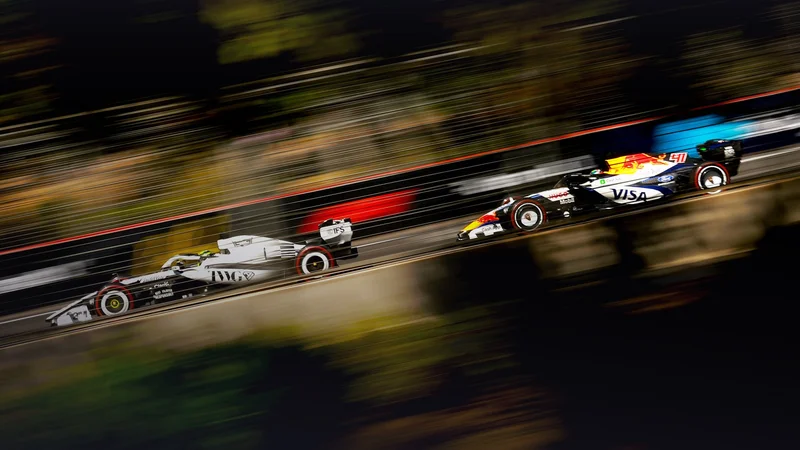



As Motorsport.com reports, the scary practice moment between Lewis Hamilton and Liam Lawson during Thursday's second practice in Baku laid bare a glaring modern problem: the massive speed disparities caused by energy harvesting. Long before anyone turned a wheel at the Baku City Circuit, drivers worried about the hazard of cars creeping slowly through the final complex to save electrical power for the main straight. In the past, traffic not setting a timed lap would sweep through the left-hander of Turn 16 and the subsequent kinks of Turns 18 and 19 at a decent clip. Now, preserving battery juice creates a wild safety margin issue against anyone arriving on a full-send push lap.
The clash itself was a textbook disaster waiting to happen. Hamilton was on an out-lap and had been warned that Lawson was storming up behind him on a flying lap. Hamilton thought he had the margin, but modern software governance caught him out. Because the car cannot command full power until a precise trigger point on the main straight to prevent the battery entering its ramp-down phase too early, the machine simply died on him right as he reached Turn 18, closing the gap in a heartbeat.
from the exit of Turn 16 through the entry of Turn 18 on slow laps, and to stay on the
"I could see him, I thought the gap was enough, I got to full throttle," Hamilton said after FP2. "Literally as I got into [Turn] 18, the car just died. Swamped up the gap massively and that could happen to anyone."
Lawson had to violently swerve his machine to dodge the crawling Ferrari, immediately venting over the radio: "Oh my god, that is so ****ing dangerous." Once the adrenaline cooled down, Lawson was pragmatic about the physics at play. "Lewis comes out of [Turn] 16 in his full throttle, he's got two or three seconds to me which is normally plenty of gap but the speed difference is just so big," Lawson said. "He's not deploying anything, I'm deploying everything and you have 60, 70, 80 km/h speed difference, which is bad."
Race director Rui Marques had explicitly instructed drivers in his briefing notes to keep "extreme left" from the exit of Turn 16 through the entry of Turn 18 on slow laps, and to stay on the "extreme right" exiting Turn 19 until reaching speed. Hamilton received a reprimand for failing to obey the strict left-side instruction during the incident, but he argued that a better structural fix is desperately needed. His proposal was simple: give cars maximum power out of the last corner on push laps so that nobody is ever forced to crawl through Turns 18 and 19.
That exact alternative was indeed brought up during Thursday night's drivers' briefing, but teams ultimately vetoed the idea. It mirrors the drama from the season-opening Australian Grand Prix, where Turn 9 at Albert Park was labeled sketchy under new technical rules due to straightline mode zones. The FIA initially planned to remove that zone ahead of FP3, only to revert after team pushback over ruined energy management preparation. Consequently, the original keep-left instructions remain firmly in place for FP3 and qualifying in Baku.