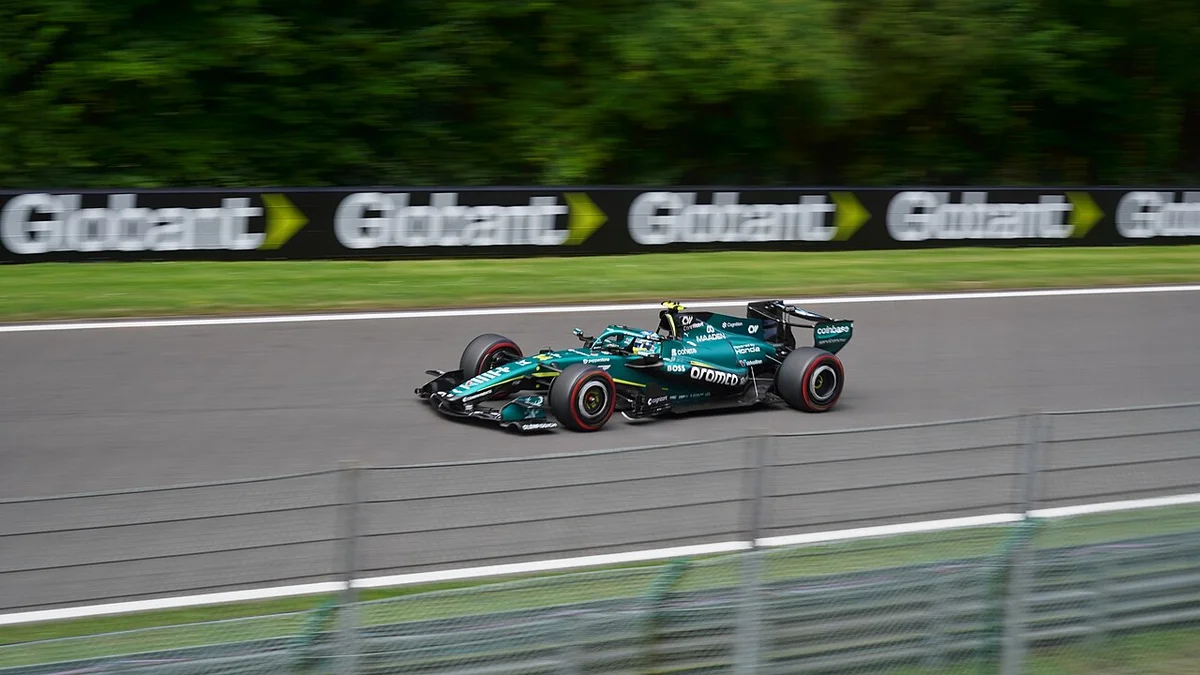


That eighth place for Fernando Alonso at Sepang might look like just another chaotic result born from a wet start and safety cars, but FormulaUno.it reports that there is a genuine turning point hiding underneath. According to FormulaUno.it, the AMR26B showed real speed not only when the asphalt lacked grip early on, but also kept a respectable pace once the track finally dried out.
A technical directive issued by the FIA before the weekend sheds light on a major factor. For the race, a power curve called Alt 1 capped electric deployment at 250 kW instead of the standard 350 kW. This restriction applied between turns 4 and 7, and again from turn 9 to 14, covering massive stretches of the circuit measuring 1550 to 2500 meters and 3100 to 4100 meters.
This wasn't merely a reaction to wet weather, but a mandatory energy configuration for the race regardless of track conditions. Throughout the season, the Honda power unit has struggled when straight-line performance dictated the lap, exposing a clear deficit on power-hungry tracks like Monza. Honda has pushed hard with developments, including a new turbocharger introduced between Spain and Baku. Capping the electric component at 250 kW across crucial sections of the lap dramatically narrowed the gap to the front-running power units.
The rain only amplified the effect during the opening laps. With low grip, raw power matters far less if you cannot put it to the asphalt, and Alonso thrived on mediums by keeping quicker machinery like Lewis Hamilton and his Ferrari SF-26 trapped behind him. Once both Alonso and Norris switched to hard tires on lap 9 with similar fuel loads, telemetry comparisons reveal a remarkably close contest. Between laps 28 and 30, Alonso lost under three tenths a lap to Norris overall, but that gap plummeted to just five hundredths of a second across the exact sections governed by the Alt 1 power restriction.

While aerodynamic efficiency and traction play their part in those sectors too, the coincidence is striking. And when the track dried completely, the AMR26B didn't collapse back into its early-season struggles. In the closing stages, Alonso matched pace with Norris directly, clocking a 1’40”353 on lap 54 to Norris's 1’39”970, and even edging the McLaren on the final tour with a 1’40”559 against a 1’40”718.
Of course, crediting the entire turnaround to a 250 kW limit would miss the bigger picture. The heavily revised version B introduced at Budapest revamped the floor, diffuser, and aerodynamic balance, turning the machine into a much more cooperative beast in the midfield. It is still not a machine boasting the peak efficiency of the absolute front-runners, but the foundational engineering is finally pointing the right way.