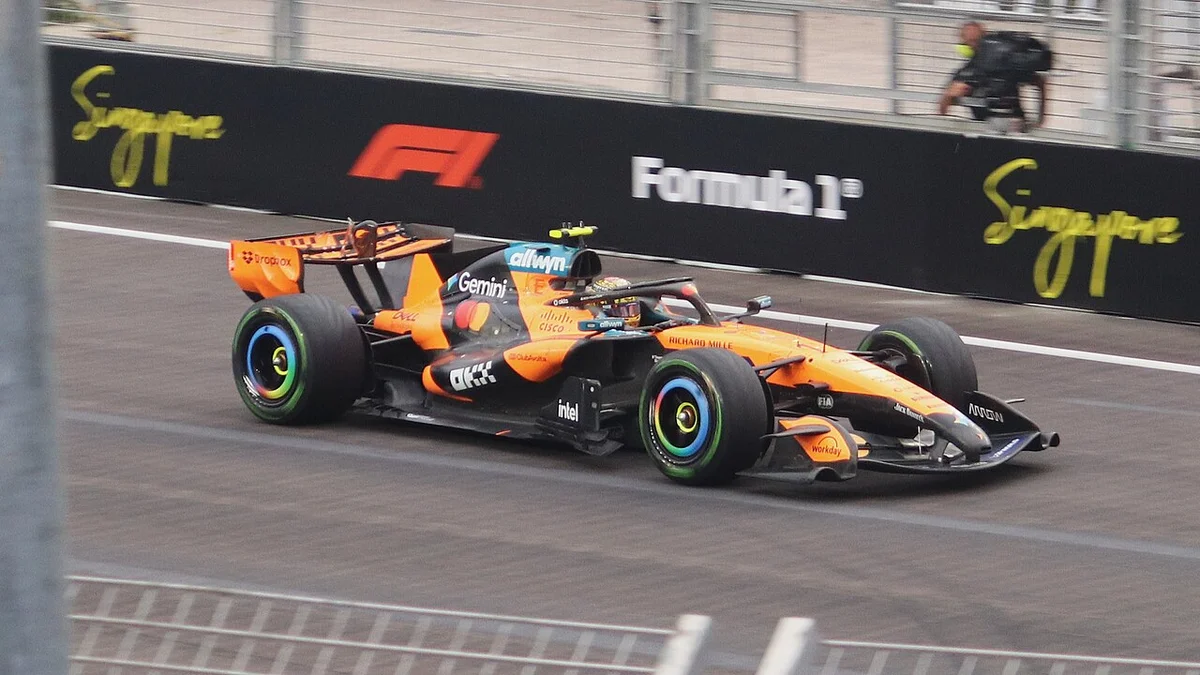


Formula 1 drivers are hoping Pirelli can make major improvements to its wet-weather range of tyres, with McLaren driver Lando Norris warning that a wet weekend in Las Vegas would be quite "scary" due to the current rubber's limitations in low temperatures.
As Motorsport.com reports, the Brazilian Grand Prix gave F1's 2026 cars their first proper wet-weather running in qualifying and the race. While the event produced an entertaining spectacle and the tyres largely functioned within their operating window, drivers were left with serious concerns. Stiffer intermediates struggled heavily in low temperatures, making the cars difficult to keep on the track during laps to the grid and at the start of stints.
Interlagos is one of the easiest circuits on the calendar for getting heat into tyres, leading drivers to worry that Pirelli's current compounds won't survive on tracks where that isn't the case—such as the upcoming Las Vegas street circuit. With temperatures dipping well below 10C in Vegas and no high-speed corners to generate lateral load, Norris did not mince words when asked about the situation by Motorsport.com. "When the tyres get cold, it's pretty nasty," Norris said. "On laps to the grid, when they get very cold, they felt horrible. If they get into a good window, they're good. So, I think the scary times are if you go to Vegas and you can't get any tyre temperature. You need a much better tyre than what we have here because that's going to be horrible."
Max Verstappen, who finished as the runner-up in Brazil, echoed those sentiments regarding the narrow operating window. "I think it's mainly that the working range is a bit too small. When they're hot, it's okay, but when they're cold, they're really like a rock," Verstappen explained, pointing to the need for a bigger working range on both extreme wet and intermediate tyres to handle heavier rain.
Williams driver Carlos Sainz also criticised the current range, stating that the level of both wet and intermediate tyres falls short. According to Sainz, the intermediate remains a weak tyre at the rear in mixed conditions, losing the front end by the time the rear finally warms up. He also pointed out severe aquaplaning and a lack of rear grip on the extreme wet compound during qualifying.
Pirelli faced a massive challenge designing tyres for the 2026 regulations, which feature high-torque power units, active aerodynamics, and soaring downforce levels driven by fierce in-season development. Although the FIA introduced a partial Straight Mode and reduced electric output in wet conditions to help safety, those changes arrived too late for Pirelli to alter its initial 2026 range. Furthermore, because Brazil's running happened so late in the year, Pirelli cannot apply its lessons to the 2027 specifications, which are already finalised.
Even so, Pirelli conducted crucial testing at Magny-Cours last month using Mercedes reserve driver Frederik Vesti to trial new intermediate compounds, structures, and tread thicknesses. Pirelli's trackside engineering chief Simone Berra confirmed they found good options to introduce next season. Meanwhile, Pirelli head of motorsport Dario Marrafuschi defended the company's progress, confirming that the manufacturer has taken driver scepticism seriously and made steps forward for 2027 based on earlier testing at Suzuka and France.


 F1
 F1