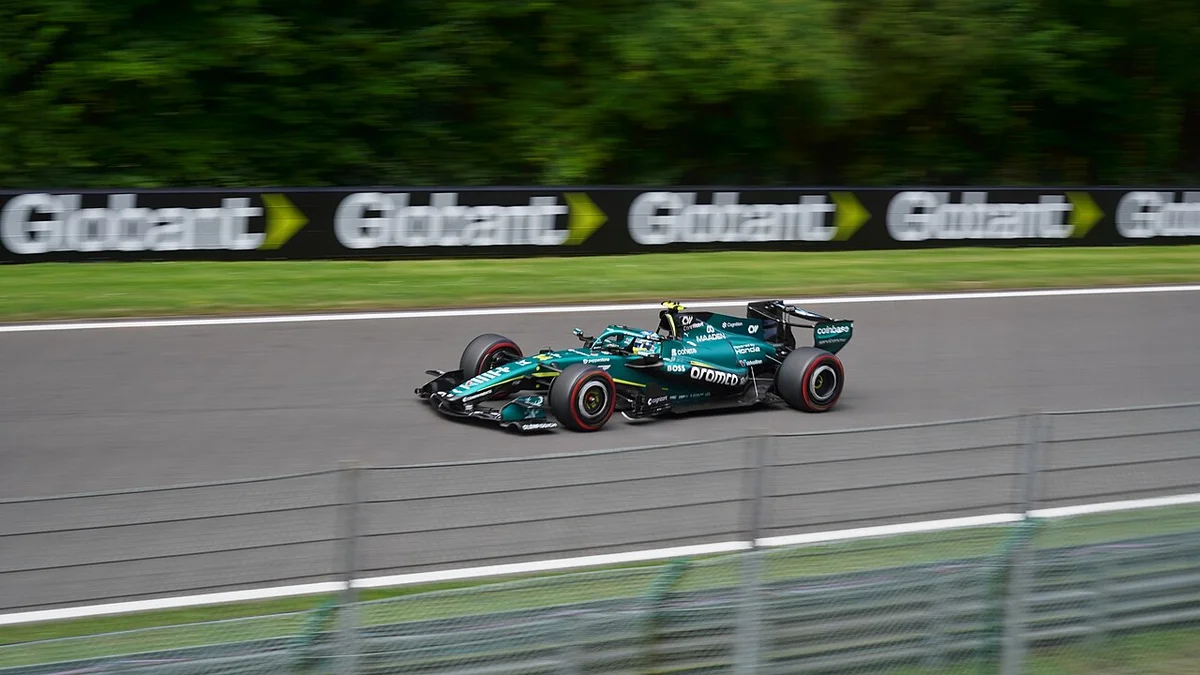


Aston Martin and Honda's form has yo-yo'd wildly this season, but as The Race reports, an even stranger subplot has unfolded around Fernando Alonso. Leaving aside his recently concluded contract negotiations, the veteran has wrestled with some very odd technical problems and retirements in comfortably the most troublesome car on the grid.
In Baku, Alonso finally got his hands on the secret ADUO 2 turbocharger upgrade that Honda had first fitted to Lance Stroll's car in Madrid. Honda introduced the mid-season ADUO 1 engine upgrade in Zandvoort to tame turbo lag and improve driveability, stopping the MGU-K from having to fill in internal combustion torque gaps with battery power. The updated Aston Martin arrived in Azerbaijan closer to the weight limit thanks to lighter rear components and that spec-2 Honda engine carrying a smaller turbo. It was working brilliantly until the castle section, after which it hemorrhaged lap time through sector three. This pointed straight to the MGU-K doing too much infilling early in the lap and creating energy deployment trouble later.
. The team opted for a pitlane start with fresh components, but once again, Honda found zero evidence of a turbo problem beyond the driver's diagnosis. Honda's fallback has been to call Alonso
This single-lap degradation towards the end of a run is a trend going back to the B-spec car's debut in Hungary last July. It even showed up in Malaysia - the car's best outing of the season - where rough tarmac and overheating tyres artificially extended slow corners and off-throttle moments where the Aston Martin is relatively stronger. Back in Baku, Alonso retired after 20 laps with what he suspected was an engine failure. "I didn't see any alarm," he said afterwards. "Pero I started losing a lot on the straight. You know, like 1.5 seconds, so something wrong." Yet when Honda checked the engine after the race, they found nothing. "At the moment the engine is OK, we don't find any issue on the data," said Honda chief trackside engineer Shintaro Orihara, noting they would check power, energy management, and GPS traces. When asked again at Sepang, Honda confirmed factory analysis still showed nothing amiss.

A similar episode struck in Singapore after another Q1 exit, where Alonso declared his turbocharger was "broken". The team opted for a pitlane start with fresh components, but once again, Honda found zero evidence of a turbo problem beyond the driver's diagnosis. Honda's fallback has been to call Alonso "the best sensor" inside the car, relying on his legendary feel. F1 history has seen elite drivers spot ghosts in the machine before, such as when Nick Heidfeld detected BMW engine management issues at Williams in 2005 that teammates Juan Pablo Montoya and Ralf Schumacher never flagged. But telemetry fidelity has evolved vastly in twenty years.
Alonso's fury boiled over on the radio while battling Valtteri Bottas's Cadillac in Baku, signaling deep frustration. Aston Martin trackside chief Mike Krack later floated the idea that the tow from the Cadillac combined with overtake mode could have tricked Alonso into feeling a non-existent engine problem. Perhaps no one will ever know for sure, but until Honda unearths something in the telemetry, the signs point to Alonso simply throwing in the towel in Azerbaijan. Given the team's woeful 2026 campaign, honestly, who could blame him?