
As FormulaUno.it reports, Charles Leclerc laid down the early benchmark by topping both practice sessions in Austin, leaving teammate Lewis Hamilton 615 millesimi adrift in FP2. Ferrari spent the morning running two distinct aerodynamic specifications before opting to mount the fresh upgrades on both cars for the afternoon. Leclerc acknowledged the gains brought by the new floor and flow management around the sidepods and rear, though he kept his expectations measured by calling the improvement limited.
The real story of the day, however, was how differently the two drivers gelled with the balance of the SF-26. Leclerc immediately found a stable, harmonious machine, while Hamilton spent Friday fighting his setup. FP1 saw Leclerc on the new package and Hamilton on the old one. While Maranello's choice to extend the parts to both cars signals a positive technical evaluation, comparing raw times from that session is tricky given differing tires, setups, and a rapidly evolving track. Telemetry mapped across sixteen geometric windows shows Hamilton was already giving away roughly four tenths in the slow corners during the morning, while the gap in fast sections remained tiny.
When the clock stopped in FP2 with both cars running the Soft tire, Leclerc posted a 1:35.291 to Hamilton's 1:35.906. Breaking down the lap reveals exactly where those 615 millesimi vanished. Lewis dropped about 342 millesimi in the slow corners and 282 in the medium-speed bends, bleeding just 27 millesimi in the fast sections while clawing back roughly 37 millesimi on the straights. These figures highlight a clear reality: Hamilton is not losing out to a slower Ferrari on the straightaways, but rather struggling to complete a corner with the same authority as his teammate.
Looking closer at the slow-speed data across six windows, Lewis leaked about 209 millesimi on entry and 340 in the middle phase, recovering 206 through the exits. The time is largely gone before the throttle is even applied, proving it is not simply a traction deficit. In the medium-speed sweepers, the delay is more spread out as Hamilton sheds 77 millesimi on entry, 168 in the middle, and 37 on exit. The SF-26 number 44 has plenty of raw speed when the power is down, but it stubbornly resists a predictable rotation during the transition from braking to cornering.
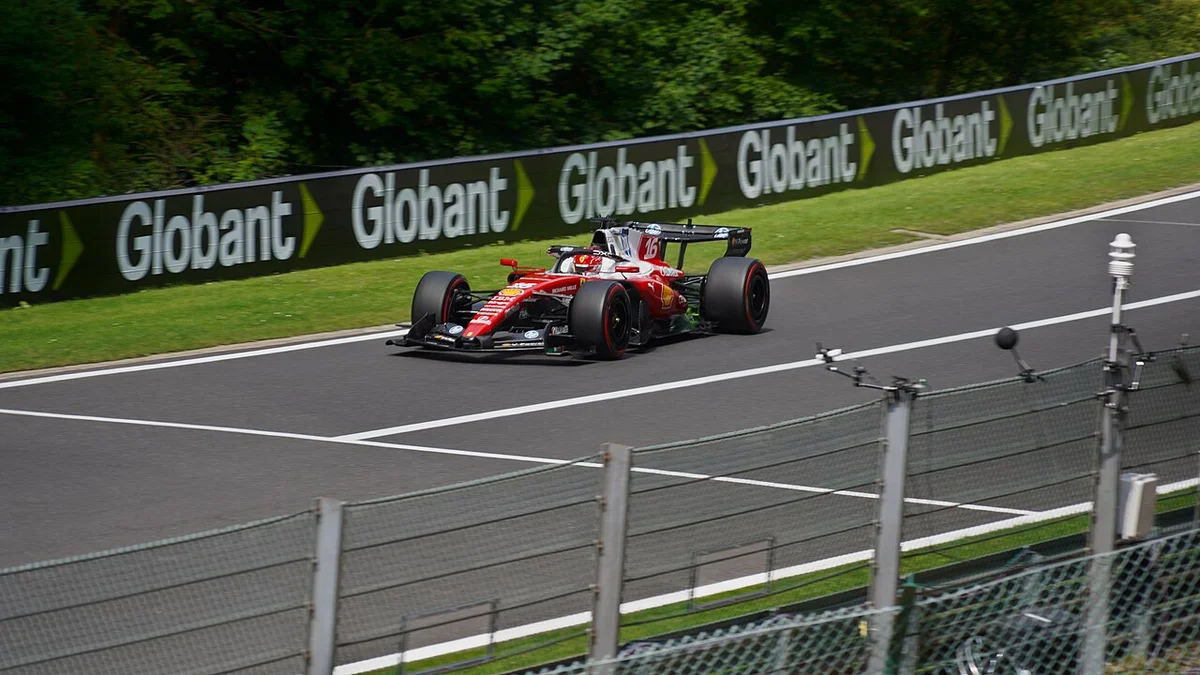
Radio communication with Carlo Santi offered a direct window into the struggle. When Hamilton asked where he was losing half a second, the engineer pointed to the apex of turn 7, the exits of 9 and 11, and the braking peak and release at turn 12. Lewis requested two points of front wing to find a sharper entry and build trust in the steering wheel. Yet throwing more front wing at the car is no silver bullet. Hamilton noted that his side of the garage took a different setup path for FP2 and found themselves wrestling with the bumps, as a platform that reacts unpredictably to load transfers can easily destabilize the rear end if the front bites too hard.
Heading into qualifying, the urgent task for Hamilton's crew is ironing out the transition from heavy braking to release while matching Leclerc's poise over the bumps. The data points unmistakably toward needing a wider, more predictable operating window rather than raw downforce alone. Leclerc's tidy lines through the final triple corner underline what happens when a driver trusts the platform beneath them. Ferrari will stick with the new floor, but Hamilton faces a race against time to unlock an asset balance that lets him attack the clock without hesitation.