As The Race reports, Formula 1's 2026 machines are running remarkably close to the pace of their ground-effect predecessors at the Mexican Grand Prix. Charles Leclerc topped the opening practice session with a 1m18.128s, outpacing his own FP1 benchmark from last year by 0.252s. It marks the first time a 2026 car has beaten a 2025 time in an FP1 session, a stark contrast to the usual two or three-second deficit we have seen all year.
Leclerc pushed harder in the second session, dropping the bar to a 1m17.827s. While that sat 0.435s behind Max Verstappen's benchmark from the previous year, the weekend's trajectory is smashing expectations. Pirelli's pre-weekend simulations originally pointed to a 1m17.0s pole position, but Friday's running blew that prediction wide open. With pole position last year sitting at a 1m15.586s and ending up 1.8s faster than FP2, the 2026 pole is expected to drop into the low-1m16s. That would produce the smallest dry-weather qualifying gap between the two generations all season, comfortably beating the previous closest margin of 1.409s set in Baku.
So why are these beasts finding so much speed here? Pirelli's chief engineer Simone Berra points to a partial resurfacing job completed ahead of the weekend, stretching from Turn 10 to Turn 1. While sector one and half of sector two retained their older asphalt, the fresh surface clearly played a part. Beyond the tarmac, track evolution is doing heavy lifting. A busier support bill featuring the one-make GTM Super Copa series, Masters Historic, and Formula 4 NACAM championship has laid down vital rubber, even if it amounts to just a 10-minute increase in pre-FP1 track time compared to last year.
The real secret, however, lies high above sea level. Mexico's extreme altitude hurts the 2026 cars and power units far less than the 2025 packages. Because the new generation generates less total downforce to begin with, they suffer less of a penalty than the aggressively downforce-dependent ground-effect cars. On top of that, the engines can push harder relative to sea-level conditions. Since electrical power remains entirely unaffected by altitude and forms a massive pillar of the 2026 power units, the dynamic shifts completely.
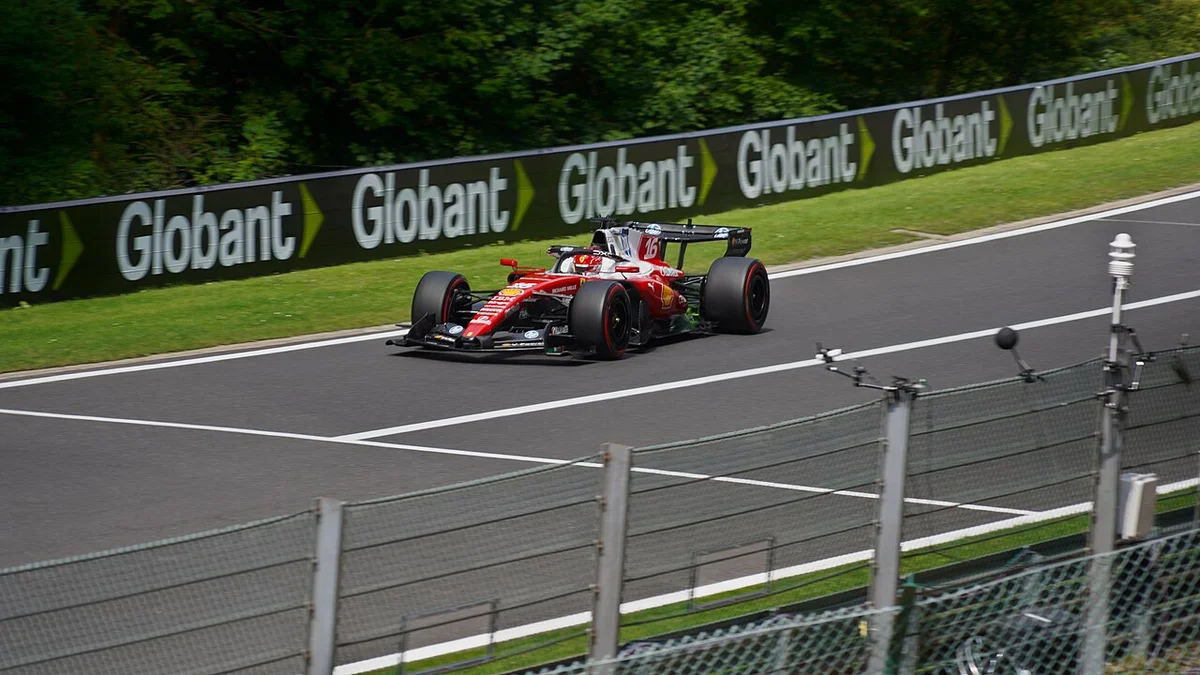
On the data sheets, the shift is undeniable. The 2026 cars are screaming down the straights faster than last year's models, holding over four tenths of an advantage on the run to the Turn 4 left-hander. That is particularly wild considering Leclerc's Ferrari is reportedly one of the weaker machines in that specific section among the top four teams due to a power unit deficit, meaning rivals comparing against Verstappen's 2026 baseline are pulling an even bigger gap.
Of course, physics eventually catches up. These machines hemorrhage that straight-line advantage through the low-speed twisty sections that follow and never claw it back. But unlike circuits like Spa, which saw a massive 3.799s gap between poles, or Monza at 2.994s, the drop-off here is surprisingly tame. With the cars ending up relatively energy-rich in the thin mountain air, Mexico has accidentally turned into a brilliant showcase for what this power unit generation can actually do.


 F1
 F1
 F1