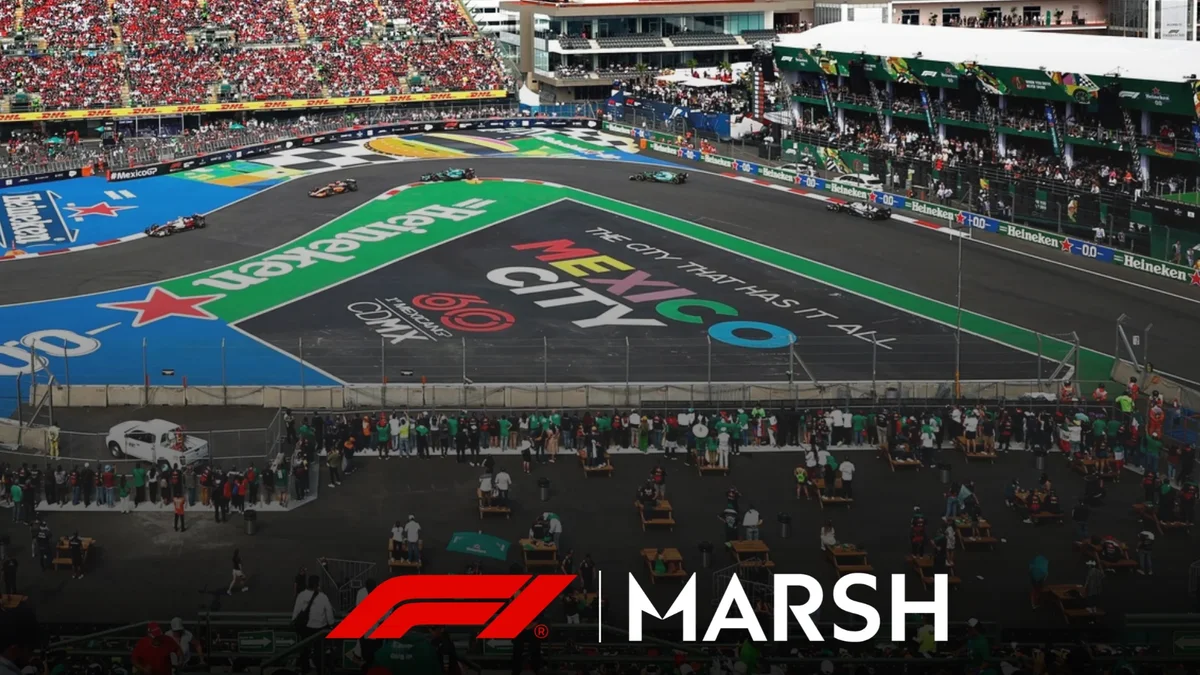


Every race demands risk for reward, but for the Mexico City Grand Prix, at the Autodromo Hermanos Rodriguez, everything tends to be a little more extreme. It is a race that breaks engines, fries brakes, breaks the spirit, and has a regular rotation of Safety Cars, VSCs, and red flags to turn races on the simple caprices of fate. All of that plays out in front of the loudest, most raucous crowd in Formula 1.
Everything that happens around the Autodromo Hermanos Rodriguez is predicated on the circuit being at 2,250m above sea-level. It is a monster poking up out of the atmosphere, standing at three times the altitude of Interlagos. There is a 20%-ish drop in air density compared to sea-level, bringing a corresponding 20% drop in downforce and cooling potential. While the turbo engines do not lose power like the old normally-aspirated units did, the turbo has to work a lot harder to deliver enough air, making this a true attrition race.
To manage the thermal loads, the cars run with big brake scoops and loose bodywork. A close look at the sidepods reveals shoulder louvres that are not normally present, and more space between bodywork and powertrain at the rear to allow for increased airflow. It creates a more draggy car as teams desperately try to secure enough cooling without taking a scrap more than necessary. Teams run with all the downforce they can possibly find, though the track still features the lowest downforce levels of the year despite cars carrying the largest wings and every winglet and gurney the teams can glue to them.
Williams Head of Race Strategy Charles-Antoine Florentin notes that the biggest trap in Mexico is overreacting to Friday. The track starts very green and rubbers-in significantly over the weekend, with degradation often reducing drastically from free practice to the race. Florentin explains that across practice they need to determine the real lap-time gaps between the three compounds, whether the soft tyre can do a meaningful race stint, how much the track will improve by Sunday, and how the power unit will cope with the altitude where turbo speed and cooling are both harder.

For Sergio Perez, happenstance means he celebrates his 300th Grand Prix start this weekend at his home race. The milestone moves the Cadillac driver above Sebastian Vettel to seventh outright on the list of Formula 1 starts. Around 150,000 fans will be crammed into the Autodromo Hermanos Rodriguez on Sunday, all chanting his name. Speaking on the unique challenge, Perez highlights that the altitude plays a massive part and puts enormous stress on tyres, brakes, and the engine as everything runs to the absolute limit. From the driver's perspective, he explains that minimizing sliding with the very low downforce is key to getting a good lap and rhythm.
History here is heavy and storied, stretching back to thrilling title showdowns like the 1968 finale at the Magdalena Mixhuca Circuit between Denny Hulme of McLaren, Graham Hill of Lotus, and Jackie Stewart of Matra. Hill ultimately clinched his double world championship after a dramatic race of attrition that saw mechanical failures strike key contenders. More recently, strategic masterstrokes like Lando Norris charging from 17th on the grid to fifth at the flag in 2023 proved that even when Saturday goes wrong, brilliant execution can salvage an unforgettable Sunday.