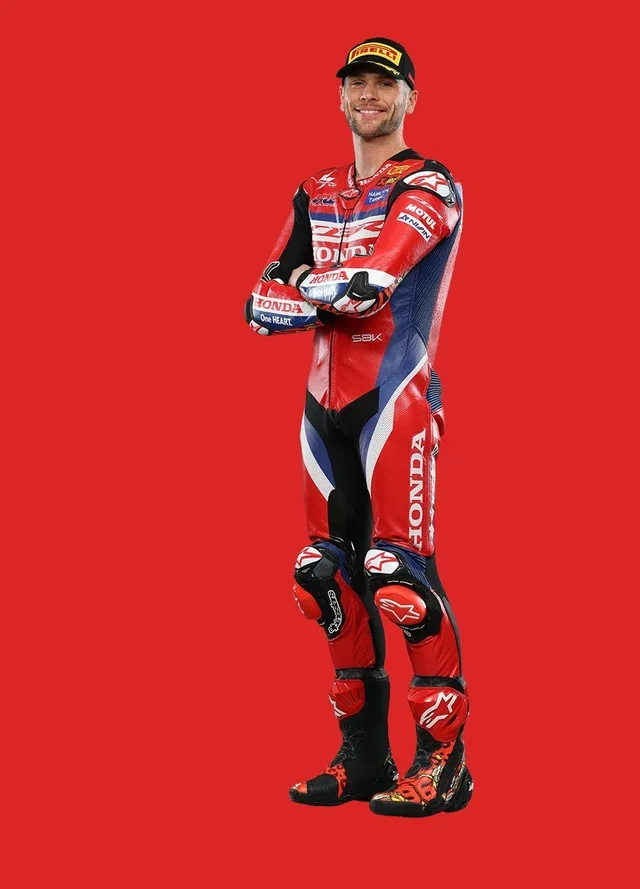
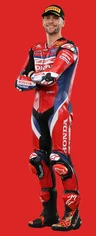
As The Race reports, Jake Dixon's unexpected cameo as a factory Honda MotoGP rider in the Qatar Grand Prix turned out to be a marvellous advert both for the rider himself and for the wider world of motorcycle racing. Yes, it was roughly 50 light-years removed from the wildcard heroics of yesteryear when a World Superbike regular like Troy Bayliss could just show up and win. Dixon didn't win, nor was he particularly close. But in the modern MotoGP reality of hyper-specialisation—featuring a grid of riders with incredible pre-MotoGP CVs and machines separated by less performance than ever—he gave a fantastic account of himself after being called up at late notice to Lusail as the replacement for the ill Joan Mir.
The progression over the weekend was clear to see in the numbers. Dixon's gap to the top Honda started at +2.2s in FP1, came down to +1.1s in Practice, sat at +1.6s in FP2, dropped to +0.9s in Qualifying, and measured +15.7s in the Sprint (with a fastest lap gap of +1.3s), before finishing at +12.5s in the Grand Prix with a fastest lap just +0.6s away. A strong baseline of initial performance was clearly built upon. He went from two seconds off over one lap to less than one, and from chewing through his tyres in the sprint to maintaining competitive pace in the main event, losing only around two or three seconds to Honda benchmark Johann Zarco across the last half of the race.
It's only now, in my latter years of being in the grand prix paddock, that I really feel like I'm now starting to come into where I feel my peak is,
It was admittedly easier to look good against such a depleted Honda roster, but Dixon had very little time to get himself up to speed. As legendary crew chief Santi Hernandez pointed out to him at the end of their weekend together, it was a total of 74 laps. "It's a day's testing, you know?" Dixon noted.
"Super happy," Dixon reflected. "Honestly, I couldn't imagine to do any better than that. In the end, I had done the in-lap, I was thinking to myself, 'This might be my last-ever time' [on a MotoGP bike]. So, I'm really going to enjoy the moment - because it might be, you know? And I proved to myself more than anything that if I had time here, I could be at the front. And I feel that. And I know it's easy to sit and say, but I generally believe that in my heart of hearts."
More than any regret, the focus rightly shifts to the implications for the here and now. It is heartening to see how good motorcycle racers are at the world-championship level. Dixon won seven of his 124 Moto2 starts. Those numbers don't scream MotoGP, but they gently suggest that a rider like this can be competent on a premier-class bike, and Dixon has now conclusively proven he could be more than that if given the time. His performance is a badge of honour for Moto2, and for World Superbikes, his current series—even if there is a negative attached.
This was Dixon's first year as a Honda WSBK factory rider, and a good chunk of it was spent recovering from a major injury to his left hand and wrist, which he feared could have been a career-ender. Even once fit, he hardly had the opportunity to make his mark. Dixon's 2026 WSBK results show him 19th in the championship with 41 points, a best finish of 6th, a median gap to pole of +1.446s, and a median gap to the winner in main races of +30.106s. With Dixon fit, the Honda Fireblade bike showed signs of life but ultimately never finished within even 10 seconds of the winning Ducati, and it was always a Ducati. The balance of power in WSBK between manufacturers is clearly less than ideal right now, but at least there is a reason to believe in the rider talent pool.
There is perhaps another consideration here, applying to both the 30-year-old Dixon and fellow great Qatar stand-in Iker Lecuona (26), both of whom have backgrounds in Supermoto competition from before entering the grand prix racing path. "It's only now, in my latter years of being in the grand prix paddock, that I really feel like I'm now starting to come into where I feel my peak is," Dixon said. "When you start so late in road racing, like 14, naturally your peak's going to be so much later - whereas they start at four, and they reach it quicker. So, I feel like now I'm just starting to come into it."
 MotoGP