
Formula 1 is officially returning to Africa. In what Formula 1 President and CEO Stefano Domenicali called "one of the most significant days in the history of Formula 1," Rwanda has locked in a 10-year deal to host the African Grand Prix starting in the early 2030s.
It is a massive moment for a championship that has been away from the continent since 1993, when South Africa held its final Grand Prix at Kyalami. Morocco’s Ain-Daib road course remains the only other African venue to host a World Championship round, back in 1958. Now, Rwanda steps up to fill that long-standing void, building on a growing sporting footprint that recently included hosting the 2024 FIA Awards and the 2025 UCI Cycling World Championships.
If you believe me a little bit, it's going to be one classic of a track immediately.
For Rwandan leadership, this is about far more than just a weekend of racing. President Paul Kagame pointed out the wider economic and continental ambitions behind the project. "For decades, African athletes have been a pillar of the global sports economy, adding significant commercial value to top leagues, with the continent receiving almost nothing in return," Kagame said. "Partnerships like the one we are building help break this cycle." Jean-Guy Afrika, CEO of the Rwanda Development Board, added that naming the event the African Grand Prix rather than a local moniker was intentional, expressing hope that it acts as a catalyst for multiple races across the continent in the future.
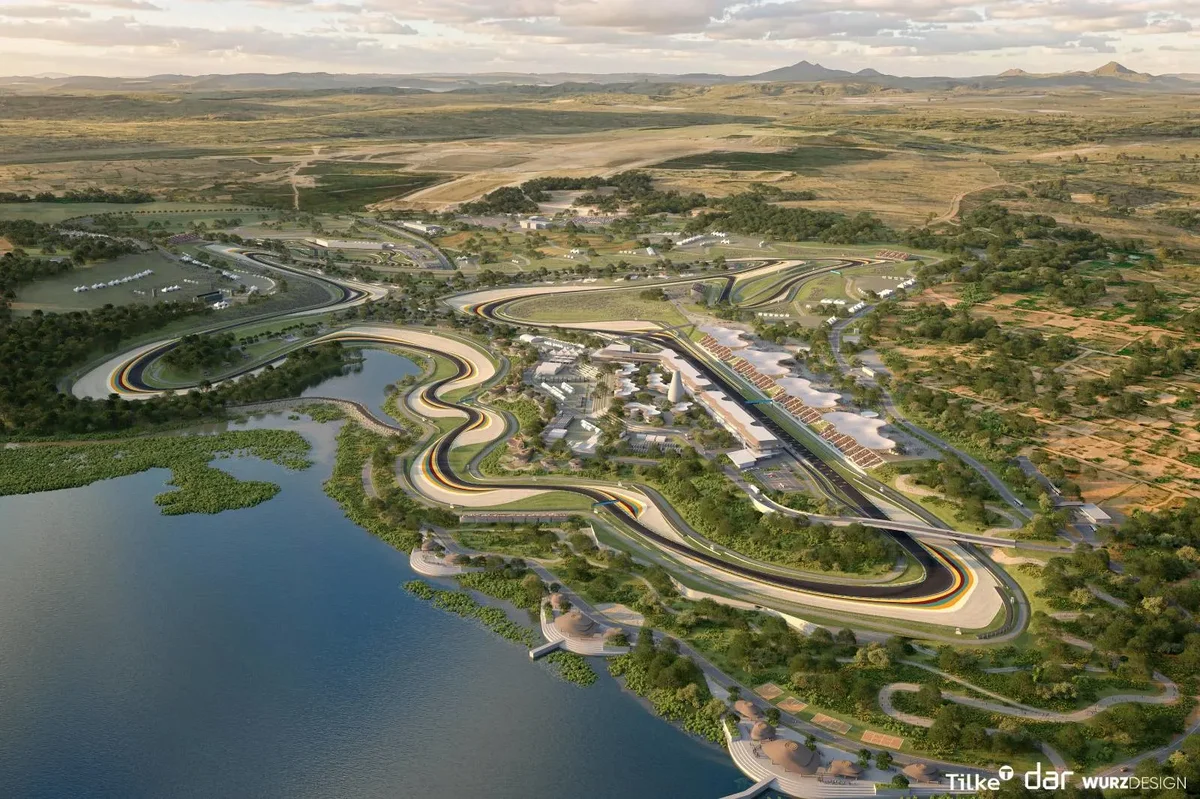
The circuit itself is being brought to life by Carsten Tilke of Tilke Engineering and ex-F1 racer Alex Wurz of Wurz Designs. Situated in Bugesera near Kigali’s new international airport—scheduled to open in early 2028—the venue capitalizes on the region's dramatic topography. "We saw it, and you see the hillsides and the lakes, I said, 'guys, there's only one location this circuit should be, because it doesn't need us to design it, because the nature designed already the perfect topography,'" Wurz explained.
The resulting layout is a 6km anti-clockwise beast featuring 17 corners and a staggering 197 metres of elevation change across a single lap. Designed to be multi-disciplinary, the facility will also house a karting track for grassroots support, a driving experience centre, and off-road courses, while the paddock structures will embrace traditional Rwandan architecture and the classic red dirt aesthetic.
At roughly 1,500 metres above sea level, Kigali will sit high on the calendar, bringing reduced air pressure and lower aerodynamic grip into play. Wurz noted that simulator work has heavily factored this in, using camber changes and tire temperature management to ensure strong racing and overtaking opportunities. "I can tell you it's going to be a drivers’ track," Wurz said. "If you believe me a little bit, it's going to be one classic of a track immediately."