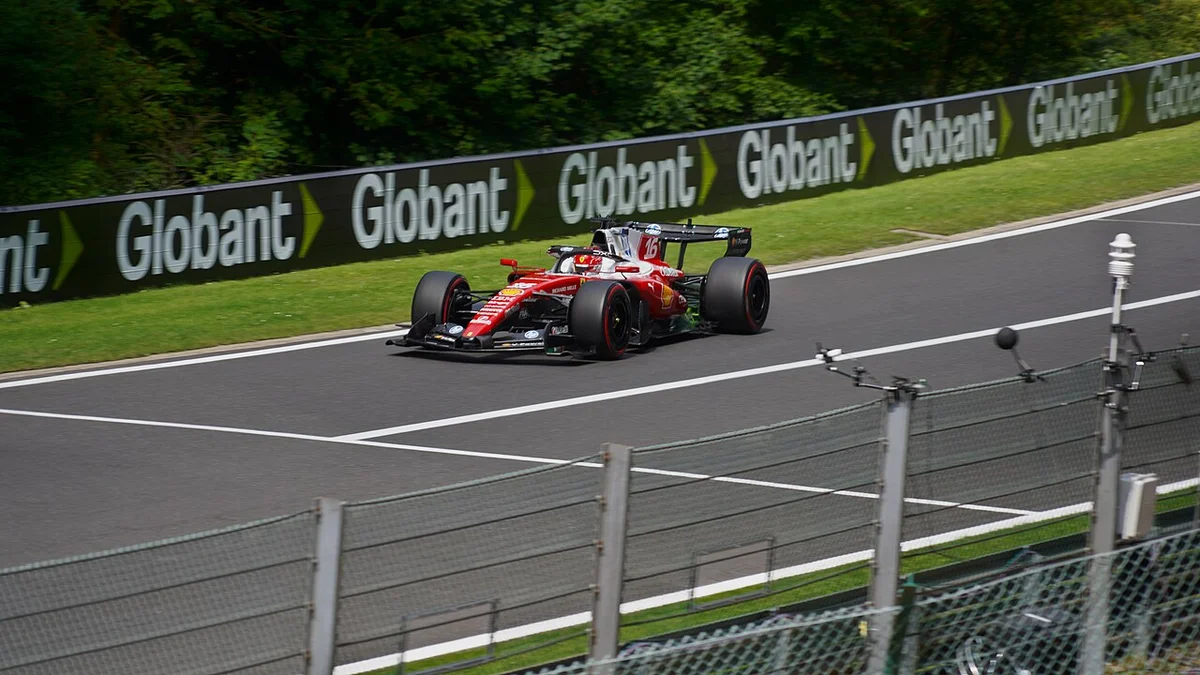


As FormulaUno.it reports, the Singapore Grand Prix laid bare a persistent vulnerability that has shadowed the SF-26 on rear-limited circuits all season. While the car can fight for pole position on a single flying lap, the rear tyres progressively lose their solidity over a longer stint. With fresh grip in qualifying, Charles Leclerc and Lewis Hamilton can carry substantial speed through the twisty sections to make up for straight-line losses. But once the rear rubber begins to degrade, sliding increases, turning that cornering speed into effective traction becomes a brutal challenge.
The early battle against Red Bull hinged on multiple factors. Verstappen started on a new Soft tyre compared to the used C5 of Leclerc, gaining an initial advantage off the line and in stint longevity. Furthermore, the RB22 grappled with a deployment glitch in the opening laps that kept Max surprisingly vulnerable. Leclerc initially misread that power drop as an isolated hiccup and failed to burn all available energy for an attack. Once Red Bull sorted the issue, the pace shifted dramatically and Verstappen checked out.
The time loss grew lap by lap in a punishing progression. Between laps 10 and 14, Leclerc leaked slightly under four tenths a tour; from 15 to 19 that gap blew past half a second, and by laps 20 to 23 it neared seven tenths. Dirty air explains only a fraction of the early deficit. Once Charles slipped beyond two and a half seconds adrift, the gap simply kept widening.
Closer inspection of the three FIA-designated Alt 2 energy management zones reveals where the bleeding accelerated. Between laps 15 and 18, Leclerc surrendered an average of 0.459 seconds per lap to Verstappen, with roughly 0.160 of that vanishing inside the Alt 2 windows. Four laps later, the total delta grew to about 0.725 seconds, yet the loss across the rest of the circuit remained locked at around three tenths. The Alt 2 zones alone blew out from roughly 160 to over 430 milliseconds. By lap 23, nearly seven tenths of Ferrari's total one-second deficit accumulated in those specific sequences alone.
At a glance, it looked like an energy harvesting flaw, but the telemetry tells a different story. In the first window, Leclerc entered the slower section slightly slower than Verstappen, yet both required virtually identical time to pick up the first 50 km/h. Red Bull's advantage materialized in the subsequent meters as Max built speed earlier. If Ferrari suffered from aggressive electrical clipping, the deficit would scale directly with speed. Instead, analysis of the third window showed Leclerc carrying a higher minimum speed of about 108 km/h against Verstappen's 104 km/h. From that apex, however, Max required 1.96 seconds to add 50 km/h, while Charles needed 2.20 seconds—nearly a quarter-second lost.
This highlights two distinct philosophies in lap-time generation. Ferrari hunts for performance while the car is still turning, packing massive entry and mid-corner speed. Verstappen happily sacrifices a touch of minimum speed, finishes rotation earlier, and points the RB22 for an explosive punch out of the corner. On a single lap, fresh rubber lets Ferrari mask straight-line compromises through pure cornering. Over a stint, that exact demand backfires.
When the rear tyres lose consistency, the SF-26 demands high lateral grip and heavy traction simultaneously. A minor slide spikes temperatures, kills grip, and worsens wheelspin the moment the driver touches the throttle. Thankfully, the post-stop switch to Medium tyres offered a clarifying reality check. Between laps 34 and 38, running identical Medium compounds, the performance delta inside the Alt 2 zones vanished entirely, turning neutral or slightly favoring Ferrari by a handful of centiseconds. A structural MGU-K deployment deficit would persist across compound changes; the fact that it disappeared proves the issue stems from tyre-rotation-traction interaction.
Hamilton's afternoon provided further proof through compound struggles. Lewis started on a new Medium to stretch the first stint, waiting for Soft degradation to swing the pendulum. That crossover never materialized. Complaining of poor pace, he was informed from the pit wall that the Soft tyre simply kept delivering superior grip. Later, during a Virtual Safety Car, Hamilton stayed out to protect track position despite Ferrari prepping a double stack. The gamble held for a few laps before the C5 rubber fell off a cliff, dropping his pace into the 1:39s and destroying any hope of defending the position.
Austin now looms as a critical examination, though Texas tends to punish the front axle more than the rear, particularly through the rapid changes of direction in the first sector. The incoming upgrade package must be judged on its ability to broaden the operating window of the SF-26 rather than merely bolting on downforce. With power unit development frozen by prior interventions, closing the straight-line gap to Red Bull relies entirely on vehicle efficiency and chassis synergy. Austin will show whether the package is an all-around step forward, though uncovering whether the rear-limited gremlins are truly fixed will demand more representative long runs on different tracks.